
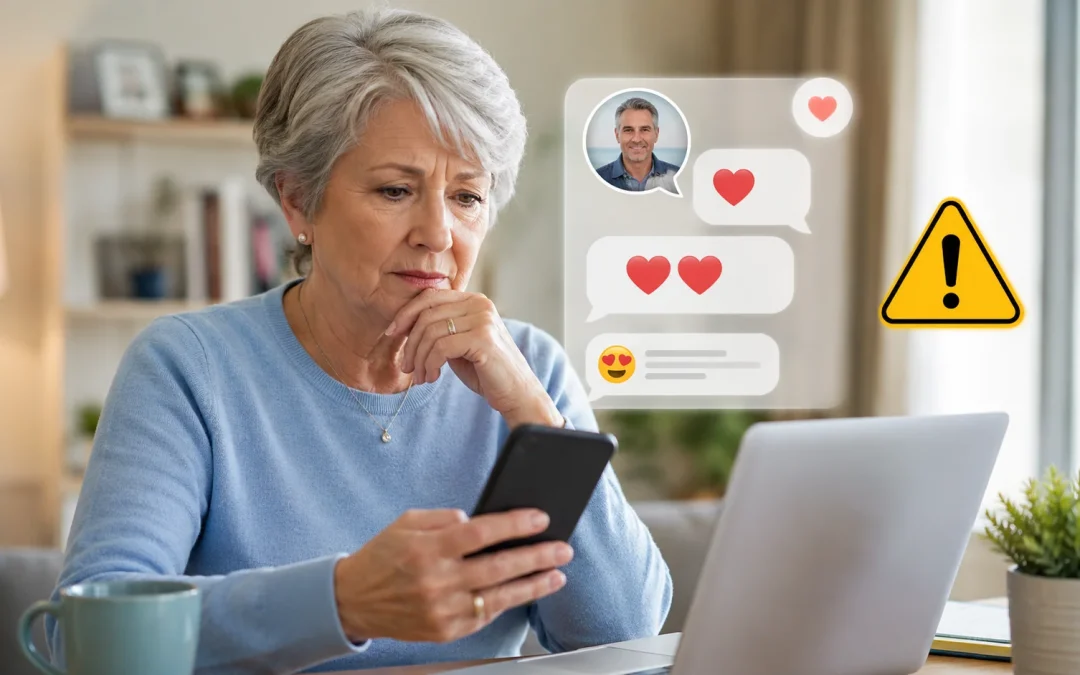
To spot a romance scam online, pause and ask yourself three questions: are they moving too fast, asking for money, or refusing to meet on video? If any answer is yes, stop replying, do not send money, and talk to someone you trust before continuing. Romance scammers are skilled at building trust and creating emotional pressure, so feeling unsure does not mean you did anything wrong. This guide is for seniors who use email, text, dating apps, or social media and want to stay safe while meeting people online.
Table of Contents
- Quick Summary
- What Is an Online Romance Scam?
- Top Warning Signs of a Romance Scam
- Common Stories Romance Scammers Use
- Why Money Requests Are the Biggest Red Flag
- The Video Call Test
- What to Do If You Think It Is a Scam
- What to Do If You Already Sent Money
- How to Block and Report the Person
- What Can Go Wrong When You Try to Block or Report
- Safety and Scam Awareness Tips
- FAQ
- Final Summary
Quick Summary
- A romance scam usually starts with someone online building trust quickly, then asking for money or private information.
- Major warning signs include fast love, excuses not to meet, secrecy, gift cards, cryptocurrency, wire transfers, or emergency money requests.
- If you are unsure, pause the conversation and show the messages to a trusted person before sending anything.
- If you already sent money, stop contact, save the messages, and contact your bank or payment company right away.

What Is an Online Romance Scam?
An online romance scam is when someone pretends to care about you romantically in order to steal money, personal information, photos, or access to your accounts. The person may seem kind, patient, and affectionate at first. That is part of the trap.
Romance scammers often contact people through dating websites, Facebook, Instagram, email, text messages, or messaging apps. They may use fake photos, fake names, and made-up life stories. They may claim to be widowed, lonely, successful, religious, military, working overseas, or looking for a serious relationship.
At first, the conversation may feel harmless. They may compliment you, ask about your life, and seem very interested in your feelings. Over time, they may say they love you, want a future with you, or feel a special connection, even though you have never met in person.
The scam usually becomes clearer when they ask for money, gift cards, cryptocurrency, wire transfers, bank help, or personal information. They may also try to move the conversation away from the original website or app to private text, email, WhatsApp, Telegram, or another messaging app so they are harder to report.
The important thing to remember is this: romance scammers are professional manipulators. Smart, careful people can still be fooled because these scams are designed to create trust, hope, and emotional attachment.
Top Warning Signs of a Romance Scam
Most romance scams follow a pattern. The details may change, but the warning signs are usually similar. If you notice several of these signs, stop and be careful.
- They move too fast: They say they love you, need you, or feel a deep connection very quickly.
- They avoid meeting in person: They always have a reason they cannot visit, even after weeks or months of talking.
- They avoid real video calls: Their camera is always broken, the connection is always bad, or they only send short clips.
- They ask for money: They need help with travel, medical bills, customs fees, taxes, business trouble, or family emergencies.
- They ask for gift cards, wire transfers, payment apps, or cryptocurrency: These payment methods are hard to reverse.
- They want secrecy: They tell you not to tell your family or friends because “they would not understand.”
- Their story changes: Details about their job, location, family, or plans do not match what they said before.
- They pressure you emotionally: They say things like, “If you really loved me, you would help me.”
- They ask for private information: They want your bank login, Social Security number, Medicare number, passwords, or verification codes.
If you notice one warning sign, slow down. If you notice several, stop replying and ask someone you trust to look at the messages with you. You can also learn more about other types of scams in This Voicemail Is Fake – Even Though It Sounds Real.
Common Stories Romance Scammers Use
Romance scammers often use stories that make it hard to question them. They want you to feel sympathy, loyalty, or urgency. The story may sound emotional, but the goal is usually to make you send money or keep the relationship secret.
Common stories include:
- “I am overseas for work.”
- “I am in the military and cannot video call.”
- “I am working on an oil rig.”
- “I am a doctor or engineer in another country.”
- “My phone camera is broken.”
- “I want to visit you, but I need help paying for travel.”
- “My bank account is frozen.”
- “I had a medical emergency.”
- “I need money for customs fees or taxes.”
- “I can help you invest in cryptocurrency.”
- “Please do not tell your family. They will not understand us.”
One story by itself does not prove someone is a scammer, but repeated excuses are a major warning sign. If someone says they love you but can never meet, never video chat normally, and eventually needs money, you should treat the situation as unsafe.
Why Money Requests Are the Biggest Red Flag
Money is the clearest warning sign in a romance scam. A real relationship should not begin with urgent requests for money from someone you have never met in person.
Never send money, gift cards, cryptocurrency, wire transfers, payment app transfers, bank account access, or verification codes to someone you only know online. It does not matter how kind they seem, how sad their story sounds, or how much they say they love you.
Be especially careful if they ask for:
- Gift cards and the numbers on the back
- Cryptocurrency or help opening a crypto account
- Wire transfers through services like Western Union or MoneyGram
- Payment apps
- Bank account transfers
- Cash mailed in a package
- Access to your bank account
- Money to “unlock” an inheritance, package, travel visa, or bank account
Scammers often ask for payment methods that are difficult to trace or reverse. They may also start with a small amount, then keep asking for more once you have already helped them once.
A simple rule can protect you: if you have not met the person in real life, do not send money.
The Video Call Test
A real person who wants a relationship should usually be willing to talk on video at some point. They may be shy or busy, but repeated excuses are a warning sign.
If someone refuses video calls again and again, pause the relationship. Scammers may say their camera is broken, their internet is bad, their job does not allow video, or they are too embarrassed. Sometimes they may send a short video clip, but that is not the same as a real live conversation.
A simple test is to ask for a normal video call where you can both talk live. You can say, “I am not comfortable continuing unless we have a real video call.” If they become angry, make excuses, or pressure you, that is a serious warning sign.
Do not accept blurry videos, silent clips, old-looking photos, or excuses as proof that someone is real. Scammers can use stolen photos, edited videos, and even fake profiles to seem believable.
What to Do If You Think It Is a Scam
If something feels wrong, you do not need to prove the person is a scammer before protecting yourself. You are allowed to pause, stop replying, block the person, and ask for help.
Here is what to do:
- Stop sending money or personal information. Do not send another gift card, transfer, code, photo, or document.
- Do not warn the person first. If you tell them you think they are a scammer, they may pressure you harder or delete evidence.
- Save the messages. Take screenshots or keep copies of texts, emails, usernames, phone numbers, photos, receipts, and payment details.
- Talk to someone you trust. Ask a family member, friend, caregiver, bank employee, or local senior center helper to look at the messages with you.
- Block and report the person. Use the block and report tools in the app, website, email, or phone where they contacted you.
If you feel embarrassed, remember this: romance scammers are trained to manipulate emotions. They often target caring, trusting people. Being targeted does not mean you are foolish.
What to Do If You Already Sent Money
If you already sent money, gift cards, cryptocurrency, bank information, or personal details, act quickly. Do not wait to see if the person “explains it.” Stop contact and protect yourself first.
Take these steps:
- Stop all contact with the person. Do not send more money, even if they promise to pay you back.
- Contact your bank or payment company right away. Tell them you believe you paid a scammer and ask if the payment can be stopped, reversed, or investigated.
- If you paid with a gift card, contact the gift card company. Keep the gift card and receipt if you still have them.
- If you sent cryptocurrency, contact the exchange or platform you used. Ask if they can flag the transaction or help you report it.
- Report the scam to the FTC at ReportFraud.ftc.gov.
- Report internet-related fraud to the FBI’s Internet Crime Complaint Center at IC3.gov.
- Save all evidence. Keep messages, receipts, wallet addresses, usernames, phone numbers, email addresses, and profile links.
The sooner you contact the bank, card company, gift card company, payment app, or crypto platform, the better. There is no guarantee you will get money back, but acting quickly gives you the best chance.
Most importantly, do not let shame keep you silent. These scams are designed to make victims feel isolated. Telling a trusted person can help you stop the damage faster.
How to Block and Report the Person
Blocking and reporting can usually be done in a few minutes. The exact buttons may look different depending on your phone, computer, or app, but the words are usually similar.
Look for options such as:
- Block
- Block this caller
- Report
- Report spam
- Report phishing
- Find support or report
- Three dots or a “More” menu
- An “i” or “Info” button
On iPhone or Android, you can usually block the person from the Phone app, Messages app, or the app where they contacted you. If they contacted you on Facebook, a dating app, email, WhatsApp, Telegram, or another service, you may need to block them separately inside that app.
If your screen looks different, do not worry. Apps change over time. The main thing is to stop replying, avoid clicking links, and ask a trusted person to help if you cannot find the block or report button.
If you are also getting unwanted texts from other numbers, you can learn more in How to Block Unwanted Text Messages on iPhone and Android.
What Can Go Wrong When You Try to Block or Report
Sometimes blocking or reporting is not as simple as it should be. That does not mean you are doing anything wrong. Phones, apps, and websites change their menus often.
If a button looks different, look for similar words like More, Options, Details, Info, Block, Report, Spam, or Phishing.
If a setting seems to be missing, the app or device may be older. In that case, you can still protect yourself by not replying, not clicking links, and deleting or ignoring the conversation.
If the scammer contacts you from a new number, email address, or profile, block that one too. Scammers sometimes create new accounts after being blocked. This does not mean blocking failed; it means they are trying again.
If you are worried your email account may be at risk, see What To Do If Your Email Gets Hacked.
Safety and Scam Awareness Tips
When dealing with possible romance scams, you should never have to pay anyone to fix the problem. Blocking and reporting are free features built into phones, computers, email services, dating apps, and social media platforms.
No one needs remote access to your device to help you block a scammer. If someone asks to control your screen, install software, or “clean” your device because of a romance scam, that may be another scam.
Never share verification codes that are sent to your phone or email. These codes are often used to log in to your accounts. If someone asks you to read a code to them, even if they say it is for “security” or “proof of love,” do not share it.
Be careful with private photos or personal documents. A scammer may later use them to threaten or pressure you. You do not owe anyone photos, documents, passwords, codes, or money just because they were kind to you online.
To better protect your accounts, you can learn about extra sign-in protection in What Is Two-Factor Authentication?
The safest habit is simple: if someone online makes you feel rushed, guilty, secretive, or financially pressured, pause and talk to someone you trust.
FAQ
Is a romance scam serious?
Yes, romance scams can cause both financial loss and emotional harm. If you think you are being targeted, stop sending money or information and talk to someone you trust.
What is the biggest warning sign of a romance scam?
The biggest warning sign is a request for money, gift cards, cryptocurrency, wire transfers, bank access, or payment help from someone you have only met online.
What if the person says they love me?
Scammers often use love and affection to build trust quickly. Real love does not require you to send money, keep secrets, or ignore your family’s concerns.
Should I video call them to prove they are real?
A real live video call can help, but it is not a perfect guarantee. If they repeatedly avoid video calls or only send short clips, treat that as a warning sign.
What if I already sent money?
Stop contact immediately, save all messages and receipts, and contact your bank, payment company, gift card company, or crypto platform right away. Then report the scam to ReportFraud.ftc.gov and IC3.gov.
Will I get in trouble for being scammed?
No, being scammed does not mean you did anything wrong. Romance scammers are professional manipulators, and the best thing you can do is ask for help quickly.
Can a family member help me check the messages?
Yes, asking a trusted family member, friend, or caregiver to review the messages can help you see warning signs more clearly. You do not have to handle it alone.
Final Summary
Online romance scams often start with fast affection, repeated excuses, secrecy, and eventually a request for money or personal information. The safest response is to pause, stop sending anything, save the messages, and talk to someone you trust. Blocking and reporting the person can help stop further contact, but the most important protection is not sending money, gift cards, cryptocurrency, codes, or bank details to someone you have only met online. If you already sent money or information, act quickly and ask for help; there is no shame in protecting yourself now.